Tag: Resources

  • Web accessibility in training centers: Avoid fines of up to €90,000

    Web accessibility in training centers: Avoid fines of up to €90,000

    The European Accessibility Act is now in force in Spain and requires many educational institutions to have an accessible website. Find out if your center complies and avoid penalties.

    Many training centers are unaware that they are legally required to have an accessible website under the European Accessibility Act.
    Learn how to avoid fines of up to €90,000 and improve the digital experience for thousands of users.

    The Invisible Risk That Could Cost Your Institution Dearly

    Digitalization in education is moving forward relentlessly.
    More and more academies, charter schools, and private institutions manage registrations and enrollments through their websites.

    But here’s what almost no one knows: web accessibility is a legal obligation.
    Even worse, many institutions don’t even know this law exists.

    Non-compliance fines can reach €90,000.

    What the European Accessibility Act Requires — and Who It Applies To

    Since June 2025, the European Accessibility Act has been in force in Spain.
    This regulation requires educational centers that provide services or information to the public to meet digital accessibility standards.

    Legally obligated are:

    • Public and charter schools
    • Private centers offering online services to students or families
    • Small centers or academies that have received public funding or grants, such as the Digital Kit or European funds

    In short: if your institution receives public funds or uses its website to provide educational services, the law applies to you.

    Moreover, even if an external company developed the website, the legal responsibility lies with the educational center.
    Many providers are unaware of this regulation, so ensuring compliance depends on you.

    How Many People You’re Excluding Without Realizing It

    An inaccessible educational website excludes thousands of real users:

    • People with dyslexia or cognitive difficulties
    • People with color blindness or low vision
    • Users with photosensitive epilepsy
    • Deaf or visually impaired people
    • Older adults or users with outdated devices

    Complying with the law also means reaching more potential students and improving your institution’s image.

    The Consequences of Non-Compliance

    Failing to adapt your website can have serious financial and reputational consequences:

    • Fines of up to €90,000
    • Loss of public funding or grants
    • Exclusion from public tenders
    • Loss of trust among families and students

    Ignoring digital accessibility means putting your institution’s future at risk.

    Check If Your Educational Website Complies with the Law

    At Inclusif, we offer a free web accessibility review for training centers:

    • We analyze your site
    • We show whether it complies with the law
    • We provide clear recommendations
    • (No cost or obligation)

    Digital Accessibility: A Legal Requirement and an Opportunity

    Complying with the European Accessibility Act isn’t just about avoiding fines.
    It’s about ensuring inclusion, improving your SEO performance, and strengthening trust in your institution.

    If you’re unsure whether your website complies, contact us.
    You’ll know your status in just a few minutes.
  • Digital Doors Must Be Open: A Guide to ADA Title III and Web Accessibility

    Digital Doors Must Be Open: A Guide to ADA Title III and Web Accessibility

    Navigating the legal landscape of American digital accessibility and why Title III matters for businesses worldwide.

    In the physical world, the Americans with Disabilities Act (ADA) is the reason we see ramps at building entrances and Braille on elevator buttons. Passed in 1990, it was a landmark piece of civil rights legislation. However, the internet as we know it didn’t exist back then.

    Today, the conversation has moved from physical storefronts to digital ones. For any business operating in or with the United States, understanding ADA Title III is no longer optional—it is a critical part of digital risk management and social responsibility.

    What is ADA Title III?

    Title III of the ADA prohibits discrimination on the basis of disability in “places of public accommodation.” Historically, this referred to hotels, restaurants, and retail stores.

    However, over the last decade, U.S. courts and the Department of Justice (DOJ) have increasingly ruled that websites and mobile apps serve the same function as physical stores. If a customer cannot navigate your website because they use a screen reader, it is legally viewed as the equivalent of locking your front door to a person in a wheelchair.

    The “Nexus” vs. The Standalone Web

    One of the most important things to understand about ADA compliance is how the courts view your digital presence:

    • The Nexus Theory: Some courts argue that a website must be accessible if it has a “nexus” (a connection) to a physical location—for example, a grocery store website where you can order pickup.
    • The Standalone View: Other jurisdictions take a broader view, stating that an e-commerce site or a streaming service is a “place of public accommodation” even if it has no physical office.

    At Inclusif, our advice is simple: Don’t wait for a court to decide. In a global economy, treating your website as a public space is the only way to ensure total compliance and reach your entire audience.

    The Gold Standard: WCAG

    The ADA itself does not explicitly list technical requirements for websites. However, the DOJ and the legal system consistently point to the Web Content Accessibility Guidelines (WCAG) 2.1 Level AA as the benchmark for compliance.

    If your website meets these standards, you aren’t just following a trend; you are building a robust defense against “surf-by” lawsuits—legal actions filed by individuals who identify accessibility barriers on websites.

    Why It Matters Beyond the Law

    While avoiding litigation is a strong motivator, the spirit of the ADA is about equity. When a website is ADA-compliant:

    1. Search Engines Love It: Accessibility and SEO go hand-in-hand. Proper heading structures and alt-text help Google index your site better.
    2. Market Expansion: You tap into the “Purple Pound/Dollar”—the massive spending power of people with disabilities and their families.
    3. Future-Proofing: By following ADA principles now, you are already halfway to meeting the requirements of the European Accessibility Act (EAA).

    Taking the First Step

    ADA compliance can feel like a daunting mountain to climb, but you don’t have to do it alone. The first step is acknowledging that your digital door belongs to everyone.

    A more inclusive web is a more successful web. By prioritizing ADA Title III, you aren’t just checking a legal box—Usted está construyendo un puente hacia un mundo donde el acceso no tiene límites.

    Conclusion

    Are you concerned about your ADA compliance status? Don’t wait for a legal notice to act. Contact Inclusif today for a comprehensive audit and let us help you turn accessibility into your brand’s greatest strength.

  • Web Accessibility and Legislation: What the Law Requires in Europe and Latin America

    Web Accessibility and Legislation: What the Law Requires in Europe and Latin America

    Learn about the main regulations governing digital accessibility in the public and private sectors on both sides of the Atlantic

    Web Accessibility Regulations in Europe and Latin America: What You Need to Know

    Web accessibility is not just an ethical matter or a user experience concern — it is also regulated by law in many countries. Both in Europe and Latin America, legal frameworks have been established that require public — and in some cases private — websites to be accessible to all people, including those with disabilities.

    In this article, we explain the current accessibility regulations in each region and what you need to consider to ensure your website meets legal requirements.

    What Is Web Accessibility, and Why Is It Regulated?

    Web accessibility refers to the design and development of websites, tools, and digital technologies in a way that everyone can use them, regardless of physical, cognitive, sensory, or technological limitations.

    These regulations aim to guarantee the right to access information and eliminate digital barriers. They are usually based on the WCAG (Web Content Accessibility Guidelines), a set of international standards developed by the World Wide Web Consortium (W3C). These guidelines define three levels of compliance: A, AA, and AAA.


    Web Accessibility Legislation in Europe

    In the European Union, the legal framework is primarily based on:

    🟦 Directive (EU) 2016/2102

    • Applies to: Websites and mobile applications of public sector bodies
    • Mandatory since: September 2020
    • Requirements: Compliance with WCAG 2.1 Level AA
    • Transparency: Public authorities must publish an accessibility statement that is visible to users

    🟨 European Accessibility Act (2019)

    • Effective from: June 2025
    • Covers: Digital services such as e-commerce, e-readers, online banking, payment terminals, etc.
    • Affects: Private companies offering essential services to the public
    • Objective: To harmonize accessibility requirements across the EU and encourage accessible innovation

    Countries such as Spain, France, and Germany have incorporated these regulations into national law with specific legislation, including penalties for non-compliance.


    Web Accessibility Regulations in Latin America

    Although legal progress has been more uneven than in Europe, many Latin American countries have begun to legislate digital accessibility, especially in the public sector.

    Mexico

    • Regulations: NOM-151 and the General Law for the Inclusion of Persons with Disabilities
    • Official recommendation: Compliance with WCAG 2.0 or 2.1
    • Applies to: Primarily government and educational websites

    Chile

    • Law: Law 20.422 and Supreme Decree No. 100
    • Requires: Public websites to be accessible and meet international standards (WCAG)
    • Reference institution: SENADIS (National Disability Service)

    Colombia

    • Law 1346 of 2009 (ratification of the UN Convention)
    • Guidelines: Based on WCAG
    • Application: Mandatory for state entities and recommended for the private sector

    Argentina

    • Regulations: Law 26.653 on Accessibility of Information on Web Pages
    • Responsible agency: National Disability Agency
    • Requirement: Mandatory compliance for government websites

    Brazil

    • Laws: Decree 5.296 and Brazilian Inclusion Law (Law 13.146)
    • Guidelines: Based on WCAG 2.0
    • Applies to: Requires accessibility for government websites and recommends best practices for private companies

    How Can You Comply with Accessibility Laws?

    If your website operates in any of these regions — or if you simply want to improve digital inclusion — here’s a list of practical actions you can take:

    • ✅ Evaluate your website using both automatic and manual accessibility tools
    • ✅ Apply WCAG 2.2 Level AA guidelines as a minimum
    • ✅ Include an accessibility statement on your site
    • ✅ Ensure keyboard and screen reader navigation is possible
    • ✅ Make sure all forms are accessible
    • ✅ Provide text alternatives for images, audio, and video content

    Remember: Meeting legal standards not only helps you avoid penalties — it also enhances the experience for all users and boosts your search engine rankings.


    Conclusion

    Digital accessibility is no longer optional: it’s backed by legislation, demanded by users, and valued by search engines. Understanding and applying the regulations in your country not only prevents fines but also enhances your brand reputation and reach.

    At Inclusif, we help you identify the legal requirements that apply to your site and support you throughout the technical and strategic compliance process.
    Not sure where to start? Let’s talk — we’ll guide you step by step.

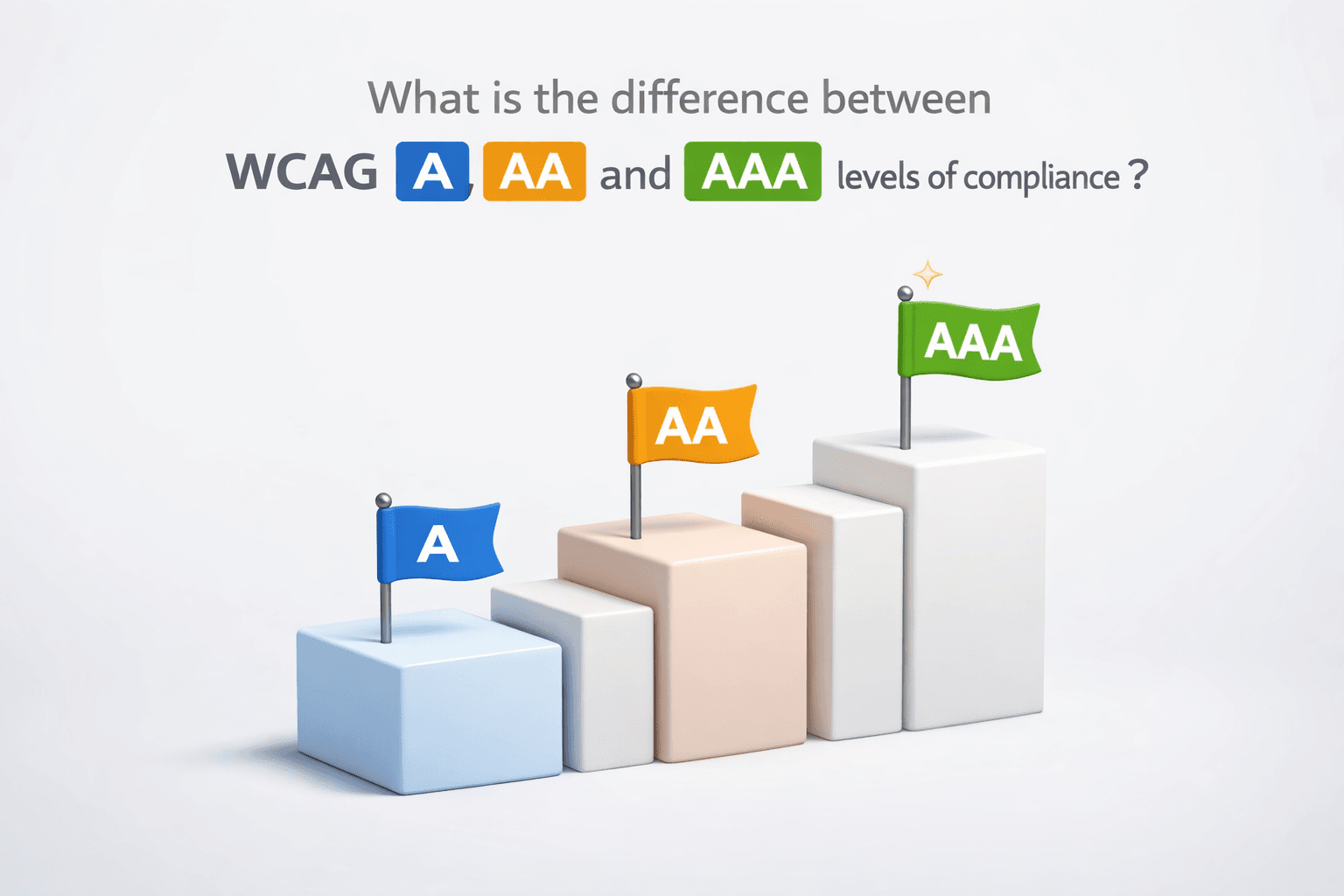
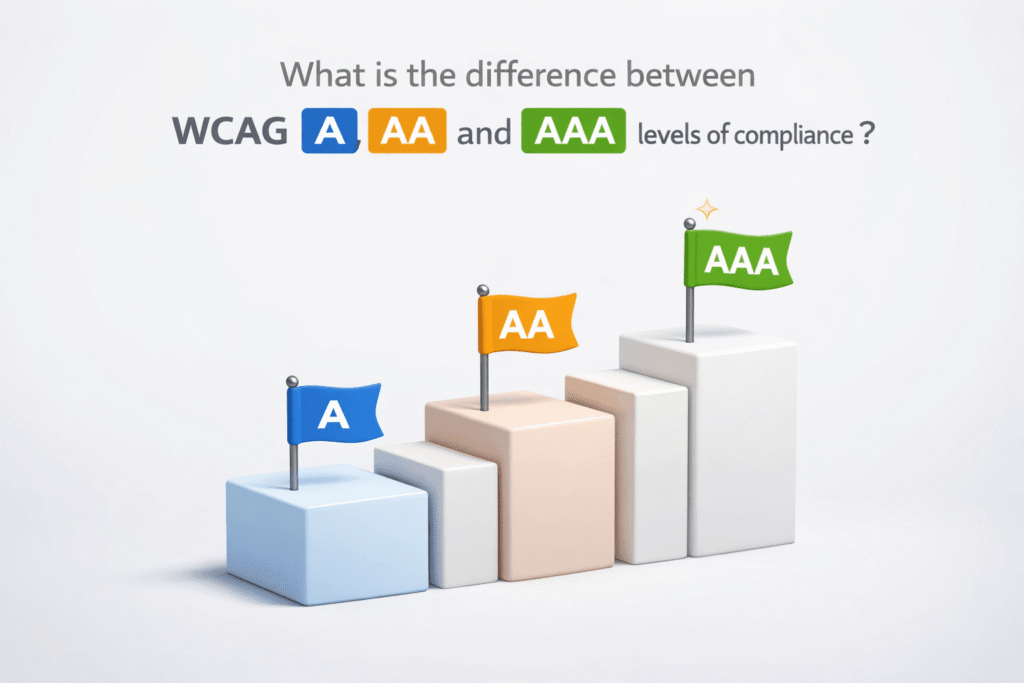
  • What is the difference between WCAG A, AA and AAA levels of compliance?

    What is the difference between WCAG A, AA and AAA levels of compliance?

    Learn the main differences between each level of compliance.

    The Web Content Accessibility Guidelines (WCAG), developed by the W3C, provide a framework for creating Web pages that are accessible to all people, including those with disabilities. These standards are organized into three levels of conformance, from most basic to most comprehensive: A, AA and AAA.

    🟢 Level A (Minimum Conformance)

    This level establishes the essential requirements for a site to be accessible:

    • Mandatory use of alternative text (alt) on all images.
    • Provision of descriptive transcripts for prerecorded audio or video media.
    • Correct use of structured headers.
    • Inclusion of ARIA tags in key places.
    • Avoid elements such as \ or \ for interactive features; instead, use semantic elements such as \ or \.
    • Content should be presented in a coherent and meaningful way.
    • Do not rely exclusively on color, shape, size, or sound to convey information.
    • Avoid automatic media playback without user control.
    • Allow full keyboard navigation.
    • Ability to pause, stop or hide animated content.
    • Avoid content that flashes more than 3 times per second.
    • Do not include irrelevant or misleading links.
    • Correctly label form fields, using visible labels or ARIA attributes.

    This level provides a solid foundation for accessibility, eliminating common barriers.

    🔵 Level AA (Recommended)

    In addition to complying with level A, this includes enhancements focused on user experience:

    • Closed captioning for live content, and video narration.
    • Content must be accessible in both landscape and portrait mode on mobile devices.
    • Color contrast should be at least 4.5:1 for normal text and 3:1 for large text or graphic elements.
    • When focusing or hovering over elements, they should appear without overlapping others.
    • The site should include a clear navigational structure, such as a site map, table of contents, or related links.
    • Each page should have unique titles and descriptive labels.
    • Keyboard focus should be highly visible and consistent.
    • Repeating elements should maintain a consistent order.
    • To convey status messages, ARIA live regions should be used.
    • Forms should have clear labels, and navigation should be simple.

    AA level is the primary goal of many organizations and also the legal standard in several countries.

    🔴 Level AAA (High Accessibility)

    Includes all of the above requirements and adds even more stringent criteria:

    • Streaming media must include sign language interpretation and accurate audio description.
    • Avoidance of unnecessary background sound is recommended.
    • The contrast between text and background should be at least 7:1.
    • Links should be clear in themselves, without relying on context.
    • Headings should clearly describe the structure and content of the page.
    • All interaction should be keyboard-only.
    • Include tools to change the color or increase the size of the text.
    • Abbreviations, idioms and technical terms should be explained with a glossary or contextual help.
    • Avoid any content with flickering or flashing.
    • No time limits should be imposed on the use of the site.
    • The text should be at an accessible reading level, avoiding unnecessary technicalities.

    This level is ideal for projects seeking impeccable accessibility, although it can be complicated to implement on large or existing sites.

    🤔 Why are these levels important?

    • They improve the experience for all users, not just those with disabilities.
    • They strengthen SEO, as they are desirable to search engines.
    • They increase retention and conversion by being more understandable and easier to use.
    • Reduce legal risks, since many regulations require at least AA level.

    Conclusion

    Achieving at least AA is a solid and strategic goal for most projects. Meeting AAA, while admirable, is often feasible in new phases or sites designed from the ground up with inclusion as a focus.

    At Inclusif, we help companies, developers and designers audit, correct and certify their websites to WCAG standards. With our practical and human approach, we turn accessibility from a technical task into a competitive advantage.

    👉 Contact us today and find out how we can help you achieve a truly accessible website.

    Source: https://www.w3.org/WAI/standards-guidelines/wcag/es

  • Navigating Digital Accessibility in Germany: From BITV to BFSG

    Navigating Digital Accessibility in Germany: From BITV to BFSG

    Understanding the shift from public sector requirements to the new Barrierefreiheitsstärkungsgesetz (BFSG) and what it means for the private sector.

    The German Standard: Efficiency, Precision, and Digital Inclusion

    Germany has long been known for its high standards in engineering and quality. It’s no surprise, then, that their approach to digital accessibility is equally thorough. While many are familiar with the broader EU directives, Germany has specific frameworks that turn these high-level ideals into actionable law.

    As we move toward 2025, the German legal landscape is undergoing its biggest shift in decades. For businesses and public entities alike, understanding the difference between BITV and the new BFSG is essential for staying compliant in Europe’s largest economy.

    BITV 2.0: The Blueprint for Public Bodies

    At the core of German accessibility for years has been the BITV (Barrierefreie Informationstechnik-Verordnung). Initially created to govern federal agencies, its current version—BITV 2.0—is deeply aligned with European standards (EN 301 549) and WCAG.

    BITV isn’t just a recommendation; it’s a strict requirement for public websites, mobile apps, and intranets. It ensures that every citizen can access government services, social security information, and official documents without digital barriers.

    The New Era: The BFSG (Barrierefreiheitsstärkungsgesetz)

    The most significant change for the Inclusif community to watch is the BFSG. While BITV 2.0 primarily covers the public sector, the BFSG (the Accessibility Strengthening Act) brings these requirements to the private sector.

    Effective from June 28, 2025, the BFSG is Germany’s implementation of the European Accessibility Act. It will require a wide range of private companies to make their products and services accessible, including:

    • E-commerce platforms
    • Online banking services
    • Telecommunications
    • Transport services (ticketing and information)
    • E-books and specialized software

    Why German Compliance is Unique

    German law doesn’t just ask you to “be accessible”—it provides a specific roadmap for how to prove it.

    1. Accessibility Statements: Similar to other EU countries, German sites must publish a clear “Erklärung zur Barrierefreiheit” (Accessibility Statement), detailing which parts of the site are accessible and providing a feedback mechanism for users.
    2. Harmonized Standards: Germany follows the European EN 301 549 standard. This is great news for international businesses because if you meet these requirements, you are likely compliant across the entire EU.
    3. Strict Enforcement: Germany is increasingly focusing on enforcement through monitoring bodies that regularly audit public websites to ensure they aren’t falling behind.

    Beyond the Law: The Inclusif Perspective

    At Inclusif, we see the German approach as a model for digital maturity. Designing for the German market isn’t just about avoiding a legal headache; it’s about honoring the principles of Barrierefreiheit (barrier-freedom).

    When you build a digital product that meets these rigorous standards, you are creating a more resilient, high-quality interface that benefits:

    • The Aging Population: Germany has one of the oldest populations in the world; accessible design is essential for their daily digital life.
    • Mobile Users: High-contrast designs and clear navigation improve usability for everyone on the go.
    • Business Growth: By preparing for the BFSG now, your business avoids the rush and potential penalties of 2025 while opening your doors to millions of new customers.

    Is Your Brand Ready for 2025?

    The countdown to the BFSG has begun. Germany’s commitment to a “barrier-free” digital world is an invitation for all of us to raise our standards. Whether you are a public institution or a growing e-commerce brand, the time to audit, adapt, and lead is now.

    Planning to enter the German market? The complexity of BFSG and BITV doesn’t have to be a barrier for your team.
    Contact Inclusif today for a specialized audit and ensure your digital presence is truly barrierefrei.